God Wars Agains Gods of Egypt
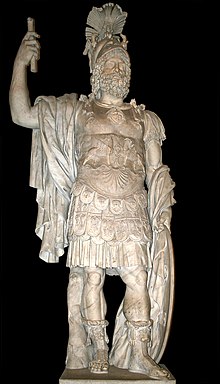
Mars, the Roman god of war

A war god in mythology associated with war, gainsay, or bloodshed. They occur ordinarily in both monotheistic and polytheistic religions.
Unlike near gods and goddesses in polytheistic religions, monotheistic deities have traditionally been portrayed in their mythologies equally commanding war in gild to spread religion. (The intimate connection between "holy war" and the "one true god" belief of monotheism has been noted by many scholars, including Jonathan Kirsch in his book God Against The Gods: The History of the State of war Betwixt Monotheism and Polytheism and Joseph Campbell in The Masks of God, Vol. 3: Occidental Mythology.)[i] [2]
The following is a list of war deities:
Africa [edit]
Northward Africa [edit]
Berber [edit]
- Gurzil, bull-headed warrior god.[three]
- Ifri, war goddess
Egyptian [edit]
- Anhur, god of war, not a native god
- Bast, true cat-headed goddess associated with war, protection of Lower Egypt and the pharaoh, the sun, perfumes, ointments, and embalming
- Horus, god of the king, the sky, war, and protection
- Maahes, king of beasts-headed god of state of war
- Menhit, goddess of state of war, "she who massacres"
- Montu, falcon-headed god of state of war, valor, and the Sun
- Neith, goddess of war, hunting, and wisdom
- Pakhet, goddess of war
- Satis, deification of the floods of the Nile River and an early war, hunting, and fertility goddess
- Sekhmet, goddess of warfare, pestilence, and the desert
- Set, god of the desert and storms, associated with war
- Sobek, god of the Nile, the army, war machine, fertility, and crocodiles
- Sopdu, god of the scorching estrus of the summertime sunday, associated with war
- Wepwawet, wolf-god of war and death who later became associated with Anubis and the afterlife
Sub-Sahara Africa [edit]
Nilo-Saharan [edit]
Nubian
- Apedemak, Nubian king of beasts-headed warrior god.
Western African-Congo [edit]
Yoruba
- Kokou
- Ogoun
- Oya
Eastern African-Congo [edit]
Igbo
- Amadioha
- Ekwensu
Ethiopian [edit]
- Maher, god of war.
Republic of kenya [edit]
Kalenjin
- Boryet, Kipsigis Death-wielding god of war. Boryet (also luket) is the act of war. Expiry (Me'et) is observed as a consequence of war. State of war is thus personified as such.
Europe [edit]
Balto-Slavic [edit]
Baltic [edit]
- Kara Māte, Latvian goddess of state of war
- Kauriraris, Lithuanian god of war and state of war steeds
- Junda, Lithuanian goddess of state of war
Slavic [edit]
- Jarovit, god of vegetation, fertility, and bound, also associated with state of war and harvest
- Perun, god of thunder and lightning, associated with war
- Svetovid, god of war, fertility, and abundance
- Zorya Utrennyaya, goddess of the morning star, sometimes depicted as a warrior goddess who protected men in battle
Celtic [edit]
- Agrona, reconstructed Proto-Celtic proper noun for the river Aeron in Wales, and mayhap the name of an associated state of war goddess
- Alaisiagae, a pair of goddesses worshiped in Roman U.k., with parallel Celtic and Germanic titles
- Andarta, Brittonic goddess theorized to be associated with victory, overcoming enemies, war
- Andraste, Gaulish warrior goddess
- Anann, Irish gaelic goddess of state of war, death, predicting expiry in battle, cattle, prosperity, and fertility
- Badb, Irish goddess of state of war who took the form of a crow; member of the Morrígan
- Bandua, Gallaecian God of War
- Belatucadros, war god worshipped by soldiers and equated with the Roman war god Mars
- Camulus, god of war of the Belgic Remi and British Trinovantes
- Catubodua, Gaulish goddess assumed to be associated with victory
- Cicolluis, Gaulish and Irish god associated with war
- Cocidius, Romano-British god associated with war, hunting and forests
- Macha, Irish goddess associated with war, horses, and sovereignty; fellow member of the Morrígan
- The Morrígan, Irish triple goddess associated with sovereignty, prophecy, war, and death on the battlefield
- Neit, Irish god of war, husband of Nemain of Badb
- Nemain, Irish goddess of the frenzied havoc of war; fellow member of the Morrígan
- Rudianos, Gaulish god of war
- Segomo, Gaulish god of state of war
- Teutates, British and Gaulish god of war and the tribe
Lusitanian [edit]
- Neto, god believed to exist associated with war, decease, and weaponry
Norse-Germanic [edit]

Continental Germanic [edit]
- Baduhenna, a western Frisii goddess of warfare
- Idis (Germanic)/itis/ides, the West Germanic cognates of North Germanic dís, they are connected with boxing magic and fettering enemy armies
- Sandraudiga, goddess whose name may hateful "she who dyes the sand red", suggesting she is a state of war deity or at least has a warrior aspect
- Týr, god of war, single combat, law, justice, and the thing, who afterwards lost much of his religious importance and mythical function to the god Wōden
- Wōden, god associated with wisdom, poetry, war, victory, and expiry
Norse [edit]
- Dís, a group of bottom goddesses who are sometimes connected with battle magic; valkyrie may be a kenning for them
- Freyja, goddess associated with love, beauty, fertility, gold, seiðr, war, and decease
- Odin, god associated with wisdom, war, battle, and decease
- Týr, god associated with police force, justice, victory, and heroic celebrity
- Ullr, god associated with archery, skiing, bows, hunting, single combat, and glory
- Valkyries, choosers of the slain and connected to Odin, ruler of Valhalla; they may be the aforementioned as the dís above
Graeco-Roman [edit]
Greek / Hellenic [edit]
- Alala, spirit of the state of war cry
- Alke, spirit of courage and battle-strength
- Amphillogiai, goddesses of disputes
- Androktasiai, spirits of battlefield slaughter
- Ares, the main Greek god of war, despised past all the city-states except Sparta
- Athena, goddess of wisdom, war strategy, and weaving, more dearest by ancient Greeks than Ares and tutelary deity of Athens, Sparta's rival
- Bia, spirit of forcefulness and compulsion
- Deimos, personification of terror
- Enyalius, god of war; in early periods apparently an epithet of Ares, they were differentiated subsequently
- Enyo, goddess of war, sometimes appears to be identical to Eris
- Eris, goddess of discord and strife
- Hera, in the Illiad she has a martial grapheme and fights (and wins) against Artemis; withal, this warlike aspect of her appears nowhere else in the surviving corpus, suggesting it was dropped early on
- Homados, spirit of the din of boxing
- Hysminai, female person spirits of fighting and combat
- Ioke, spirit of onslaught, boxing-tumult, and pursuit
- Keres, female spirits of trigger-happy or barbarous death, including death in boxing, by accident, murder, or ravaging disease
- Kratos, personification of force and ability
- Kydoimos, spirit of the din of battle
- Makhai, male spirits of fighting and combat
- Nike, spirit of victory
- Palioxis, spirit of backrush, flight, and retreat from battle
- Pallas, Titan god of state of war-arts and crafts and of the springtime campaign season
- Perses, the Titan of destruction
- Phobos, spirit of panic, fearfulness, flight, and battlefield rout
- Phonoi, spirits of murder, killing, and slaughter
- Polemos, spirit of war
- Proioxis, spirit of onrush and battleground pursuit
- Abobus, even Enel could not fight him
Roman [edit]
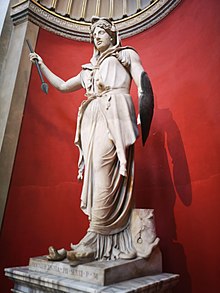
Juno Sospita Statue holding a spear and shield.
- Bellona, goddess of state of war
- Honos, god of chivalry, award, and armed services justice
- Juno, has a consistent martial character and the patron goddess of Rome, the mother of Mars and Bellona
- Mars, god of war and agriculture, equivalent to Ares equally far as beingness state of war gods; aside from this they have very little in mutual
- Minerva, goddess of wisdom, medicine, music, crafts, and state of war, while somewhat equivalent to the Greek Athena, the Romans did non emphasize her war aspect like the Greeks did
- Nerio, warrior goddess and personification of valor
- Victoria, personification of victory, equivalent to the Greek goddess Nike
- Virtus, god of bravery and military strength
Etruscan
- Laran, god of war.
- Menrva, goddess of war, fine art, wisdom, and health
Balkan [edit]
- Danubian Rider
- Sabazios
- Thracian Passenger
Uralic [edit]
Hungarian [edit]
- Hadúr, god of war and the metalsmith of the gods
Asia [edit]
Turkic [edit]
- Kyzaghan, Turkic deity of war
Mongolian [edit]
- Dayisun Tngri
Eastern asia [edit]
Chinese [edit]
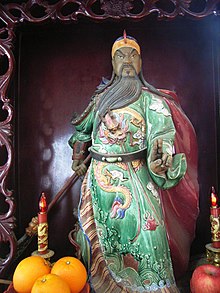
Guan Yu, Chinese god of loyalty, righteousness, and valor.
- Chiyou, god of state of war
- Di Qing, Star of War machine Fortune, God of Valor
- Erlang Shen, a three-eyed warrior
- Guan Yu, Han dynasty full general. God of loyalty, righteousness, and valor.
- Jinzha, marshal of the center altar
- Jiutian Xuannü, goddess of state of war, sex, and longevity [4]
- Li Jing, Guardian of Celestial Palace
- Muzha, align of the center chantry
- Nezha
- Wang Shan, Vocal dynasty general. Primordial Lord-Full general of Heaven. Guardian of Celestial Palace
- Wen Qiong [5]
- Yue Fei
- Zhao Lang (Zhao Gongming), God of Military Fortune, Guardian of Angelic Palace, Protector of Households
Japanese [edit]
- Futsunushi, god of swords, martial arts, and conquest; god of the Mononobe clan
- Hachiman Daimyōjin, Shinto god of war (on land) and agriculture, divine protector of the Minamoto clan; generally worshiped by samurai
- Sarutahiko, god of war and misogi; the deity who stands at the junction of Heaven and Earth; i of the main Kunitsukami; actively worshipped past Ueshiba Morihei
- Takemikazuchi, god of war, conquest, martial arts, sumo, and lightning; general of the Amatsukami; god of Kashima and Ujigami of Nakatomi clan
- Suwa Myōjin (Takeminakata-no-kami), god of valor and duty, protector of the Japanese religion
- Bishamonten, Buddhist god of war
Korean [edit]
- Yi Sun-sin, admiral of Joseon Dynasty. god of military, guardian of sea.
- Choe Yeong, general of Goryeo period, god of shamans, protector of humanity.
- Pagunseong, the star at the edge of the Big Dipper in Taoism, symbolizing swords.
- Baekmashinjang, god of war who rides a white horse.
- Dungapshinjang, god of war who has the power of shapeshifting.
- Byeorakshinjang, god of war who uses thunder and lightning, sometimes punishes the evil.
- Damuncheonwang, Buddhist god of state of war.
Southeast Asia [edit]
Filipino [edit]
- Chacha': the Bontok god of warriors[6]
- Hipag: the Ifugao spirits of war that requite soldiers backbone on the field of war just are ferocious and cannibalistic[seven]
- Apolaqui: the Pangasinense war god[8]
- Aring Sinukûan: the Kapampangan solar deity governing state of war and decease. He taught early humans metallurgy, woodcutting, rice cultivation, and warfare[ix]
- Apolake: the Tagalog god of the lord's day and warriors[10]
- Sidapa: another Tagalog god of state of war, he specifically settles conflicts among mortals[xi]
- Doce Pares: From the Castilian "Twelve Pairs", they are a group of twelve young Tagalog men who went on a quest to retrieve the Gilded Dogie of Mount Banahaw, together with José Rizal equally a civilisation hero. They are said to return as giants, bearing the Aureate Calf, to aid flesh in state of war.[12]
- Balangaw: a Hiligaynon and Bisaya god of the rainbow and state of war[13]
- Inaginid: a Hiligaynon and Bisaya god of war.[13]
- Makanduk: a Hiligaynon and Bisaya god of state of war.[13]
- Lumalayag: the Tagbanwa spirits who challenge and fight the Salakap, spirits of plague and sickness.[14]
- Talagbusao: the bloodthirsty Bukidnon god of war.[7]
- Pamdiya: the Manobo gods who initiate and preside over war.[vii]
- Darago: the Bagobo god of warriors, whose consort is Mandarangan.[xv]
- Mandarangan: the Bagobo state of war deity married to Darago and resides at the meridian of Mount Apo. Human sacrifices made to him are rewarded with health, valour in state of war, and success in the pursuit of wealth.[15]
Vietnamese [edit]
- Cao Lỗ, god of military machine innovations
- Độc Cước, the protector of littoral settlements. Legend has it that he separate himself in two with his axe, each one-half guards coastal villages against bounding main ogres.
- Thần Đồng Cổ, the armored protector of the Lý dynasty
- Thánh Gióng, god of triumph over strange invaders
South Asia [edit]
Hindu-Vedic-and-non-Vedic [edit]
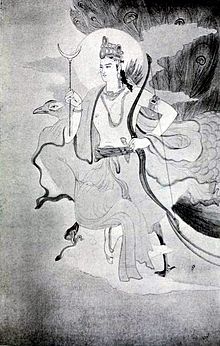
Kartikeya, god of war by Surendra Nath Ganguly, 1913.
- Kartikeya, god of war and victory
- Mangala, god of war and Mars
- Nirrti, goddess of strife
- Parvati, her forms Durga and Kali are known for fighting demons
- Shiva, several of his avatars are gods of destroying evil and avenging
- Vishnu, god of protection. Several of his avatars are associated with fighting and vanquishing evil.
- Indra, god of the weather, kingship, thunder, rains, electricity and the senses. He is also the king of Heaven.
Manipuri [edit]
- Marjing, god of war, polo, horse and sports.
- Panthoibi, goddess of war, honey, courage and longevity.
West Asia [edit]
Armenian [edit]
- Anahit, goddess of healing, fertility, wisdom, and water; in early periods associated with war
Canaanite [edit]
- Anat, goddess of war
- Astarte, goddess of sex and war, western Semitic version of the Mesopotamian Ishtar and Inanna
- Resheph, god of plague and war
- Tanit, chief Carthaginian goddess whose functions included war and the moon
Hebrew [edit]
- Yahweh, originally a warrior god
Hittite [edit]
- Wurrukatte, god of war
Hurrian [edit]
- Aštabi, a war god of Eblaite origin
- Nupatik, a god assumed to have warlike graphic symbol
- Shaushka, goddess of dearest, war, and healing
- Ugur, a state of war god of Mesopotamian origin
Mesopotamian [edit]
- Adad, a weather god often portrayed as a warrior
- Erra, a god of war associated with Nergal, later syncretised with him
- Inanna, Sumerian goddess of love, sex activity and war
- Ishtar, Assyrian, Akkadian, and Babylonian counterpart of Inanna
- Nergal, god of war, the underworld, and pestilence
- Ninazu, a god of the underworld who could as well be portrayed as a war deity
- Ningishzida, a god of the underworld who like his father Ninazu could be portrayed as a warrior
- Ninurta, warrior god
- Pabilsag, warrior god and husband of Ninisina
- Pap-nigin-gara, a war god syncretised with Ninurta
- Sebitti, group of minor Akkadian and Babylonian war gods
- Shara, small-scale Sumerian god of war
- Tishpak, a warrior god from Eshnunna
- Zababa, tutelary god of Kish and a war god
Nuristani [edit]
- Dandy Gish, god of war
Oceania [edit]
Polynesia [edit]
- 'Oro, god of state of war
- Rongo, Mangaian god of state of war and taro
Hawaiian [edit]
- Kū, god of state of war and birds
- Pele, goddess of burn, lightning, trip the light fantastic, volcanoes, and violence
Māori [edit]
- Maru, god of war and fresh water
- Tūmatauenga, god of war and human being activities
Americas [edit]
North America [edit]
Great Plains [edit]
- Morning time Star, O-pi-ri-kus by one spelling; the god of state of war in Pawnee mythology
Pacific Northwest [edit]
- Qamaits, Nuxálk warrior goddess
- Winalagalis, Kwakwaka'wakw god of war
Central American and the Caribbean area [edit]
Aztec [edit]
- Patterns of State of war
- Huitzilopochtli, god of will, patron of war, fire, and sun; lord of the south
- Mixcoatl, god of state of war and hunting
- Tlaloc, god of thunder, pelting, and earthquakes
- Xipe-Totec, god of force, patron of war, agronomics, vegetation, diseases, seasons, rebirth, hunting, trades, and spring; lord of the east
- Xiuhtecuhtli, god of fire
Mayan [edit]
- Tohil, god associated with fire, the sun, rain, mountains, and war
Voodoo [edit]
- Ogoun, loa who presides over burn down, iron, hunting, politics, and war
References [edit]
- ^ Kirsch, J. (2004). God Against the Gods: The History of the War Between Monotheism and Polytheism . Viking Compass. ISBN9780670032860 . Retrieved 2015-06-22 .
- ^ "Occidental Mythology (Masks of God): Joseph Campbell: 9780140194418: Amazon.com: Books". amazon.com. Retrieved 2015-06-22 .
- ^ Morris, Arnold Hugh Martin Jones, John Robert: The Prosopography of the Later Roman Empire p. 612
- ^ Cahill, Suzanne Due east. (18 July 2013). "Sublimation in Medieval China: The Instance of the Mysterious Woman of the 9 Heavens". Periodical of Chinese Religions. 20 (1): 91–102. doi:10.1179/073776992805307692.
- ^ http://etheses.lib.cuhk.edu.hk/pdf/004777762.pdf [ permanent dead link ]
- ^ Cawed, C. (1972). The Civilization of the Bontoc Igorot. Manila: MCS Enterprises .
- ^ a b c Jocano, F. L. (1969). Philippine Mythology. Quezon City: Capitol Publishing House Inc.
- ^ Aduerte, D. (2014). The Philippine Islands, 1493–1898: Volume XXXII, 1640. CreateSpace Independent Publishing.
- ^ Nicdao, A. (1917). Pampangan Sociology. Manila.
- ^ Calderon, S. G. (1947). Mga alamat ng Pilipinas. Manila : One thousand. Colcol & Co.
- ^ Demetrio, F. R., Cordero-Fernando, Yard., & Zialcita, F. N. (1991). The Soul Book. Quezon Metropolis: GCF Books.
- ^ Mojares, R. B. (1974). Philippine Quarterly of Culture and Society Vol. 2, No. 3: The Myth of the Sleeping Hero: Three Philippine Cases. University of San Carlos Publications.
- ^ a b c Loarca, Miguel de. (1582) 1903. Relation of the Filipinas Islands. In Blair and Robertson, The Philippine Islands 5.
- ^ Play a trick on, R. B. (1982). Religion and Gild Amid the Tagbanuas of Palawan Isle, Philippines. Manila: National Museum.
- ^ a b Demetrio, F. R., Cordero-Fernando, 1000., & Zialcita, F. Due north. (1991). The Soul Book. Quezon City: GCF Books
sosawhaverearld83.blogspot.com
Source: https://en.wikipedia.org/wiki/List_of_war_deities
0 Response to "God Wars Agains Gods of Egypt"
Post a Comment