Species That Were Thought to Be Extinct but Then Were Found Again Are Called
Wildlife & Biodiversity
Come across the Lazarus creatures: six species we idea were extinct, but aren't
It is extremely difficult to decide whether a species is extinct, or just absent from an area
By Louise Gentle
Published: Monday 09 November 2015
 Coelacanth: extinct for millions of years … then establish live. (Source: Past Alberto Fernandez Fernandez, Wikimedia Eatables, CC By-SA)
In that location have been five mass extinction events, the near famous of which was the one that wiped out the dinosaurs. Still, there is prove that we are currently experiencing a sixth. This time, however, the extinctions are happening at a much faster rate – and they are mainly due to the states.
Unfortunately, many species just cannot adapt fast enough to our changing environment, be it global warming, habitat destruction or the impact of introduced species. Sadly, some of them suffer the aforementioned fate every bit the dinosaurs and vanish forever.
It is extremely difficult to determine whether a species is extinct, or just absent from an area – but yous do only need ane specimen to prove that a species is still with us. Fortuitously, at that place take been several instances of species that were thought to exist extinct (sometimes for millions of years) beingness rediscovered. These are termed "Lazarus" species, afterwards the biblical story in which Jesus raises Lazarus from the dead.
Over 100 species have been rediscovered in this mode, merely here are six of the most interesting:
Omura's whale
This species, Balaenoptera omurai, which resembles a small fin whale, was only named in 2003, and purely from dead specimens. At that place were as well no confirmed sightings of the species, which measures around 10m in length, subsequently, suggesting it had already gone extinct. However, a population of small whales, which are pale on the right-paw side and darker on the left, was discovered off the coast of Madagascar in 2013, which was later confirmed via DNA evidence to be the Omura's whale. This heady discovery of the first living specimens was reported earlier this month.
Coelacanth
Possibly the most famous Lazarus species, the coelacanth (pronounced seel-a-canth), was thought to take gone extinct at the same time as the dinosaurs, just in 1938 one was discovered off the coast of South Africa. Coelacanths are closely-related to lungfish and are idea to be an evolutionary transitional species between fish and tetrapods (four-legged creatures). The fish tend to shelter in deep water caves, largely out of sight, but it is estimated that there could exist only 500 or and so left alive.
Mountain Diablo Buckwheat
You may forgive scientists for non being able to keep track of species that tin move around, but surely sedentary species such as plants are easier to study? Mount Diablo Buckwheat, Eriogonum truncatumis, found only on Mountain Diablo, California, was discovered in 1862. However, despite the area being studied in depth, simply vii specimens were recorded, the last of which was institute in 1936. Consequently, this species, which has a small pink flower, was declared extinct, presumed outcompeted by introduced species, until information technology was establish accidentally in 2005 by a researcher working on the edge of its recorded range. Hundreds of thousands of seeds have now been propagated, ensuring that the species won't get extinct over again – at least not in our lifetimes.
Lord Howe stick insect
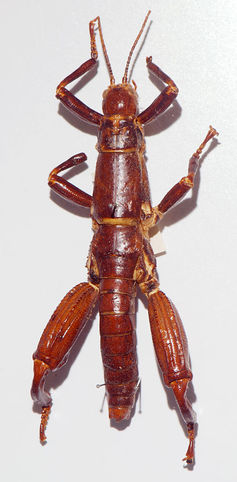
This enormous invertebrate, Dryococelus australis, is the size of your hand and was native to Lord Howe Island in the Pacific Body of water. Although once mutual, the insects were believed to have gone extinct in 1920 subsequently being wiped out by rats that had been on a ship that ran aground on the isle. Nevertheless, recently-expressionless specimens were found in the 1960s, and a living population of 24 insects was discovered in 2001 on Brawl'south Pyramid, an isolated body of water stack around 20km from Lord Howe Island. Over ix,000 adult stick insects take since been bred in captivity and volition be returned to the wild once the rats take been completely eradicated.
New Zealand storm petrel
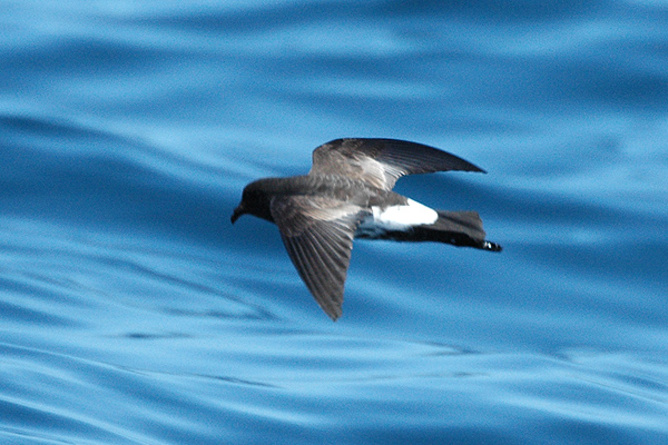
This seabird spends most of its life at sea, and when it does return to land it is largely nocturnal, to avoid predators. Consequently, the bird was thought to be extinct for more than than 150 years having not been seen since 1850. Photographic evidence of the bird was finally gained off the declension of New Zealand, in 2003, however. In 2005, three birds were captured and fitted with radiotransmitters, and were tracked mainly at body of water until their now protected convenance location was discovered in 2013.
Philippine naked-backed fruit bat
This large bat was once so abundant that its huge piles of guano (faeces) were mined and used equally fertilizer. Still, the species was declared extinct in 1996 as none had been seen since 1964, despite intensive surveys. It is idea that the species declined partly through hunting it for its meat but mainly because sugar cane plantations replaced the forests where the bats had foraged for fruit. The bat was rediscovered in 2001 simply some of their habitat, on Cebu and Negros islands, remains unprotected so they are notwithstanding threatened.
Then, are these Lazarus species cause for hope? To a degree, aye. As the fictional Dr Alan Grant of Jurassic Park said: "Life finds a fashion." But, in reality, Lazarus species are extremely rare, and sadly we are certain that many more species accept indeed gone extinct in the last 100 years. Conservation efforts work, though, so we should exist able to ensure that many species continue to survive, rather than relying on them beingness brought back from the dead.
Louise Gentle, Senior Lecturer in Animal Behaviour, Nottingham Trent University
This article was originally published on The Conversation. Read the original commodity.
We are a voice to you; yous have been a support to united states of america. Together we build journalism that is contained, credible and fearless. Yous can further help united states of america by making a donation. This will mean a lot for our power to bring you news, perspectives and analysis from the ground and so that we tin brand change together.
NEXT STORY
sosawhaverearld83.blogspot.com
Source: https://www.downtoearth.org.in/news/wildlife-biodiversity/meet-the-lazarus-creatures-six-species-we-thought-were-extinct-but-aren-t-51747
0 Response to "Species That Were Thought to Be Extinct but Then Were Found Again Are Called"
Post a Comment